Tour de Yorkshire in Leeds

On 5th July 2014 198 professional bike riders lined up on The Headrow ,close to Leeds Town Hall, for the start of stage 1 0f the Tour de France. So began Yorkshires love affair with cycling. Hundreds of thousands of people lined the roads for the two days the event was in Gods own country and their enthusiasm and support surprised both organisers and riders alike.  Villages and town en route had spent weeks preparing, yellow painted bikes were everywhere, the bunting was out and cycling related art installations were in the fields. Travelling the route today some of the yellow bikes are still there. It led to the race director Christian Prudhomme describing it as “the grandest of Grand Departs.”

The following year The Tour de Yorkshire began as a three day legacy event and attracted some of the top world professional teams and the support from the people of the county was no less enthusiastic. Now in its fourth year it has been extended to a four day stage race for men and a two day race for women. The final stage of the mens raced finished back in Leeds, only a few metres from the start line of the 2014 Tour. In many ways cycling in Yorkshire has come full circle.

It has been estimated that over 2.5 million people watched the 2018 race during its four day duration. The crowds at the finish were loud and vocal hours before the riders arrived as they gave support to the hundreds of amateur cyclists that had completed the  Maserati Tour De Yorkshire sportive.

Huge screens enabled spectators to watch the race as it developed over the roads of west Yorkshire. The arrival of the publicity caravan an hour before the riders added to the already great atmosphere on the finish line.


The final stage was won by Stephane Rossetto who broke away from the main peloton early in the stage and rode for 120Km on his own to claim victory. He had built up a lead of over nine minutes during the stage but this as gradually whittled down and he crossed the finish line with only 34 seconds to spare.

The overall race was one by Greg Van Avermaet who finished second on the stage

As the 2018 tour comes to an end we hear that discussions are underway to bring the Vuelta (Tour of Spain) to Yorkshire. I am sure that this is an excellent move for both parties. Fingers crossed and lets hope that it happens soon.

A Fine Walk in the English Lake District

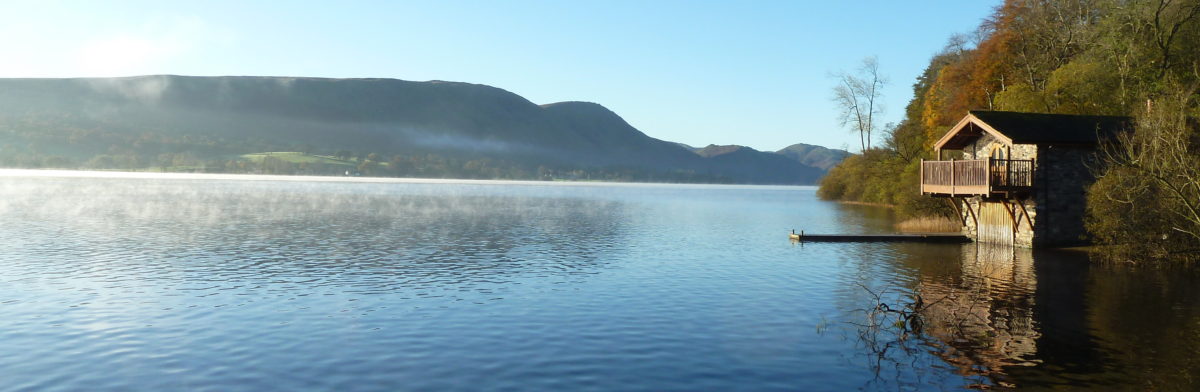
What constitutes a good walk? Stunning scenery, a not too difficult ascent to a good view, a waterfall, shaded woodland? Sometimes a compromise has to be made but on this particular walk you get the whole lot in a not too difficult 41/2 mile (7Km) walk near Lake Ullswater on the eastern edge of the Lake District. Even better there is a pub at the end of it.

Detailed easy to follow, instructions can be found in the book Pocket Pub Walks by Jean Patefield.  The walk has a climb up Gowbarrow fell followed by a gentle descent with some stunning views of Ullswater Lake and a visit to Aira Force waterfall.

There are two possible starts to the walk. The first is from the carpark at Aira Force but prefering to keep the waterfall until the end of the walk it is also possible to start from the village of Dockray on the A5091 where there is limited parking by the bridge in the centre of the village.

The walk to the summit of Gowbarrow Fell follows a wall for most of the way and can be rather muddy in places. It is not too steep and a stop to rest gives great views behind you as you gain height. A trig point marks the summit and on a clear day you can see for miles around.

After retracing steps a short way from the summit the path continues to the right and eventually will give some superb views of Ullswater. On a clear, blue sky, day it is simply stunning and you are largely able to enjoy it on your own give or take the occasional walker.

Aira Force is the 66 foot drop created by the Aria Beck as falls down a steep ravine on the final stage of its route to Lake Ullswater.

The car park for the waterfall has a cafe and toilets. The car park is a blessing and a curse as it means that the area around the falls are very busy and noisy. From the falls it is a short walk, first through woodland and then open country, back to Dockray village. As most people only visit the falls from the nearby carpark the route is very quiet.

Liverpool’s Musical Statues

Liverpool is a city blessed with a fine variety of statues, non more so than those that celebrate the musical icons associated with the city. For this post I will concentrate on those easily located in and around the city centre but those that arrive via the airport may well encounter a rather famous figure in the terminal building.

Ken Dodd – Lime Street Station Concourse

The statue is part of an installation entitled “Chance Meeting” by  Liverpool sculptor Tom Murphy which also features Bessie Braddock who was a Liverpool Labour MP for over 30 years. The installation is usually to be found on the concourse of Lime Street station but was removed in autumn 2017 to allow for redevelopment of the station. Following the death of Ken Dodd his statue was replaced on temporary basis until the full installation is reinstalled at the end of building work. Although perhaps better known as a comedian he had 18 chart hits, mainly in the 1960s, his version of Tears selling well over a million copies.

Eleanor Rigby – Stanley Street

Eleanor Rigby was a song on The Beatles album Revolver as well as a number one single in 1966. The sculpture was made by Tommy Steele in 1982 in recognition of the work of The Beatles and their place in the city. His fee for the work was a reported three pence. Tommy Steele himself was a singer and actor in musical theatre before becoming a sculptor.

In the work she is sitting alone with her shopping at her side and her head turned towards a small bird that is on an old newspaper. There is room on the bench for you to join her. The ‘real’ Eleanor Rigby is buried in the churchyard of St Peters Parish Church, Woolton in the city.

Cilla Black – Mathew Street

Commissioned by her sons following her death in 2015, it was unveiled in January 2017 which coincided with the 60th anniversary of The Cavern Club where she worked before embarking on her singing and television career. Made by Andy Edwards and Emma Rodgers the dress has been sculpted with square panels which contain song titles etc. Cilla Black released nineteen top forty singles, mainly in the 1960s, including number one singles Anyone Who Had a Heart and You’re my World in 1964.

John Lennon – Mathew Street

Made by Liverpool artist Arthur Dooley the statue of John Lennon is one of the oldest musical statues in the city. Lennon stands against a wall opposite The Cavern, the bricks are engraved with the names of all the artists and bands that have played there.  A Tom Murphy statue of Lennon is to be found at Liverpool airport to commemorate its renaming as the John Lennon Airport in 2002.

The Beatles – Pier Head

Andy Edwards statue of the Fab Four was donated to the city by the Cavern Club in 2015 to commemorate 50 years since their last appearance in the city, which was at The Empire Theatre on Lime Street. Arthur Dooleys “Four Lads Who Shook the World” installation on Mathew Street celebrated Beatle Street and their importance. This gives us the group as slightly larger than life characters looking as if they are casually walking to catch the nearby Birkenhead ferry and gives you a much greater sense of them as individuals.

Edwards has given each Beatle a personal touch; Paul McCartney carries a camera, George Harrison wears a belt with Sanskrit writing, Ringo Starr has L8 on his shoe and John Lennon holds two acorns in his hand.

Billy Fury – Albert Dock

The Tom Murphy statue of Billy Fury was moved to its current location opposite the Piermasters House at the Albert Dock in 2007. Billy Fury achieved most of his success in the rock and roll boom in the early sixties. He is much loved in the city and by his fan club who commissioned the statue in 2003. The flowers around the statue were to commemorate his birthday which was on the 17th of April.